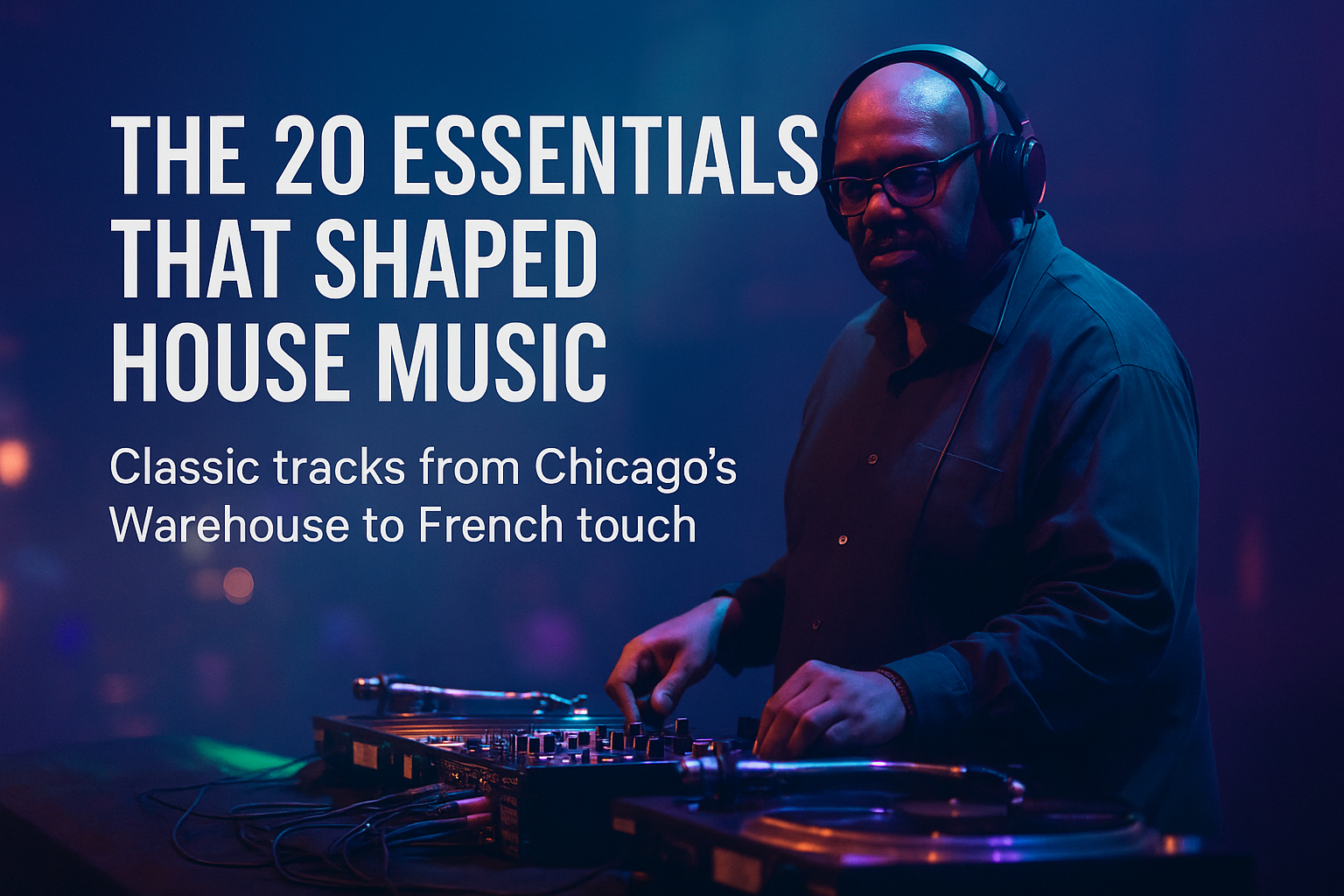
From a Chicago warehouse to global festival main stages, house music fused disco’s euphoria with machines—drum computers, samplers, and synths—to invent a new way to dance. Born around Frankie Knuckles’ legendary residency at The Warehouse in the late ’70s and early ’80s, the sound spread through clubs like the Music Box, Power Plant, and beyond, inspiring scenes in Detroit, Manchester, New York and Paris. Here’s a guided tour through 20 cornerstone tracks and what they unlocked for the genre.
How house music took its name (and sound)
The Warehouse gave the genre both its name and its blueprint: four-on-the-floor kicks, hypnotic basslines, chopped vocals, and joyful piano stabs. DJs stretched disco into something leaner and more electronic, using the Roland TR-808/909, TB-303, and early samplers to sculpt a futuristic pulse.
Chicago: the spark that lit the world of House music
- Jesse Saunders – “On and On” (1984)
Often cited as the first pressed house record, it translates DJ blend culture into a minimal 808 workout. - Marshall Jefferson – “Move Your Body (The House-Music Anthem)” (1986)
The piano-house blueprint and a manifesto in one: house music all night long. - Mr. Fingers (Larry Heard) – “Can You Feel It” (1986)
Deep, meditative, and soulful—this is where deep house finds its voice. - Adonis – “No Way Back” (1986)
Stark drums and a dystopian hook; proof that minimal ideas can feel massive on a system. - Chip E – “Time To Jack” (1986)
A shout-out to the dance itself; raw drum programming that defined early floors. - Phuture – “Acid Tracks” (1987)
The TB-303 squelch that birthed acid house—initially baffling, ultimately explosive. - Lil’ Louis – “French Kiss” (1989)
A 10-minute slow-down/speed-up odyssey; bold structure, bolder sensuality. - CeCe Rogers – “Someday” (1987/89)
Marshall Jefferson’s production + gospel-schooled vocals = house as community and hope. - Cajmere – “Coffee Pot (It’s Time for the Percolator)” (1992)
Playful, percussive, unforgettable—Chicago’s oddball streak at its finest.
Detroit & the UK: parallel paths, shared DNA
- Model 500 (Juan Atkins) – “No UFOs” (1983/1990s mixes)
Detroit’s sci-fi precision edges house toward techno, influencing Chicago in return. - Inner City – “Good Life” (1988)
Kevin Saunderson channels disco’s joy through 909 muscle—pure crossover magic. - A Guy Called Gerald – “Voodoo Ray” (1988)
A UK acid landmark: dubwise sensibility meets 303 hypnosis. - 808 State – “Pacific State” (1989)
Sunkissed pads, a sax hook, and breakbeat touches—Manchester’s Balearic dream.
New York & the East Coast swing
- Hardrive – “Deep Inside” (1993)
Louie Vega & Kenny Dope distill NY house: chopped diva vocals, chunky drums, irresistible groove. - Robin S – “Show Me Love” (1993)
The Korg M1 hook that conquered radio without losing club bite.
Piano, passion, and progressive pressure
- Gat Decor – “Passion” (1992)
Euphoric piano riffs + sleek arrangement—progressive house in embryo.
House music ’s vocal drama & pop crossover
- Farley Jackmaster Funk & Jesse Saunders – “Love Can’t Turn Around” (1986)
Darryl Pandy’s towering vocal takes house to mainstream TV and charts. - Jamie Principle & Frankie Knuckles – “Your Love” (1984/1986; ’90s pressings)
From bedroom reel-to-reel to club classic; sensual synth arpeggios that later echoed through pop.
French touch and late-90s sparkle
- Stardust – “Music Sounds Better With You” (1998)
One perfect single: filtered-disco loop, breezy topline, eternal summer.
Why these tracks still matter
- They codified the palette. Pianos, 909s, 303s, chopped vocals—these ingredients still power today’s house music from deep to tech to melodic.
- They centered community. Lyrics about release, unity, and the dancefloor as sanctuary remain central to the culture.
- They encouraged mutation. Each record opened doors: acid squelch, progressive builds, soulful NYC swing, French filter magic.
Listening starter pack (then and now)
- Classics to queue: Move Your Body, Can You Feel It, Your Love, Good Life, Voodoo Ray, Passion, Music Sounds Better With You.
- Modern takeaways: focus on a solid groove, a memorable hook (piano, vocal, or bass), and economy in arrangement—most of these legends win by doing less, better.
The legacy of house music
Call it Chicago’s greatest cultural export: house music turned marginalized dancefloors into global community. It taught producers to treat machines like instruments and made the club a place of healing and joy. Whether you gravitate to deep, tech, progressive, or piano house, the road still leads back to these 20 milestones—and the beat goes on.
Discover more from Silvano Dio
Subscribe to get the latest posts sent to your email.