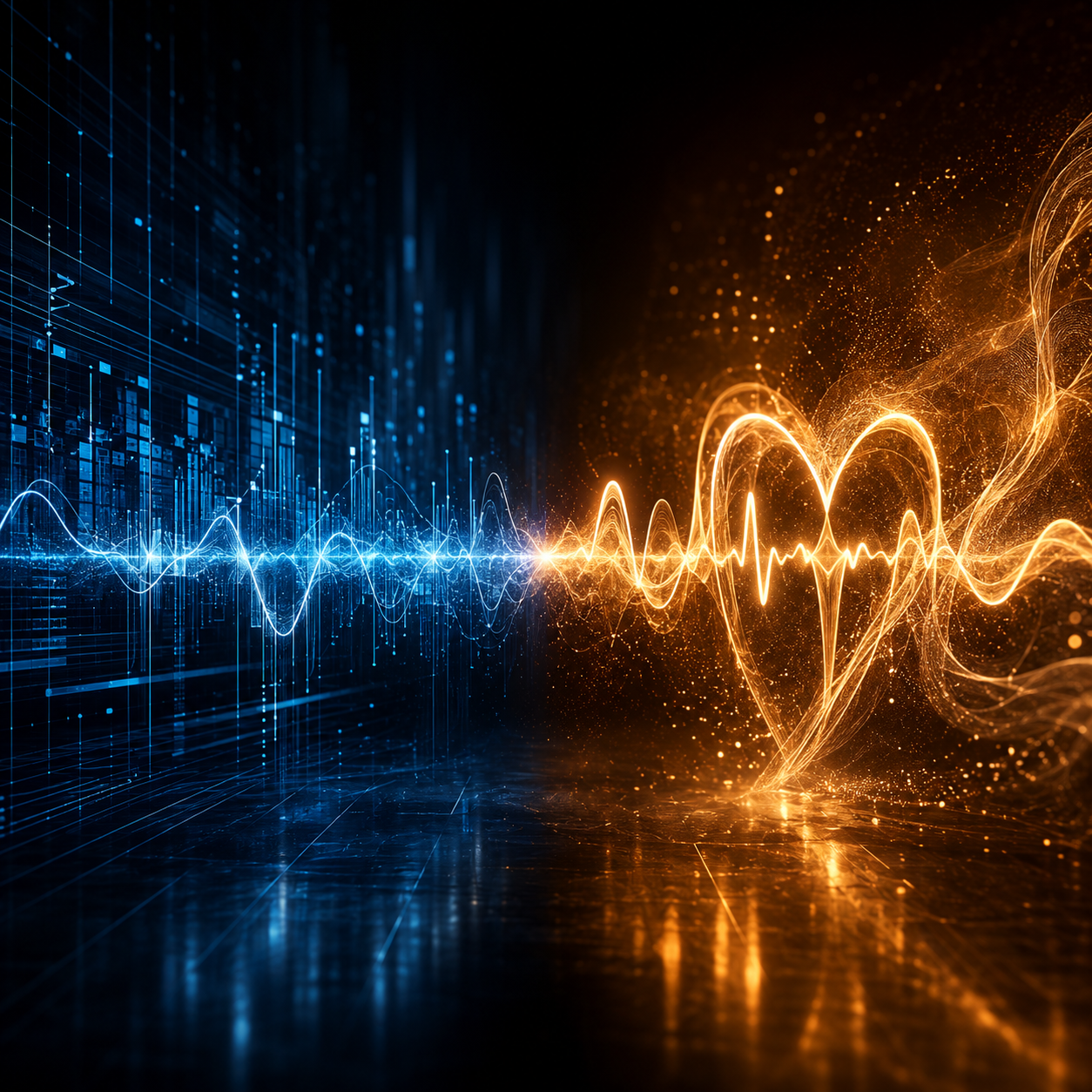
Artificial intelligence is changing music faster than many artists expected. AI tools can now generate songs, imitate styles, suggest arrangements, create vocals, assist with mastering and produce convincing tracks from a simple prompt. For electronic music producers, this opens exciting creative possibilities — but it also raises an important question: if machines can generate music, what still makes human-made music meaningful?
The answer is not only technical. It is emotional. Music is not just a sequence of chords, rhythms, textures and frequencies. It is also memory, intention, vulnerability, identity and feeling. In electronic music especially, where technology has always been part of the creative process, the real challenge is not whether AI can make sound. The challenge is whether that sound can carry a human reason to exist.
That is why human emotion still matters in the age of AI music. The future of electronic music will not be defined only by who can generate the most tracks. It will be defined by who can create music that feels alive.
AI music is no longer a distant idea
AI-generated music is not a futuristic concept anymore. It is already part of the current music landscape. Platforms, distributors, producers and listeners are all facing a new reality where fully AI-generated tracks can be created and uploaded at massive scale.
In April 2026, Deezer reported that AI-generated tracks represented roughly 44% of all new daily uploads on its platform. That means almost 75,000 AI-generated tracks per day. This number is important because it shows that the issue is no longer about a few experimental tools. It is about volume, visibility and the future structure of music discovery.
But quantity does not automatically create connection. A track can be generated quickly, uploaded instantly and still disappear without meaning anything to anyone. In a world where music becomes easier to produce, the emotional reason behind the music becomes even more important.
Electronic music has always used technology
It would be too simple to present AI as the enemy of electronic music. Electronic music has always been built with technology. Synthesizers, drum machines, samplers, sequencers, digital audio workstations, plugins and algorithmic tools have shaped the genre from the beginning.
The question is not whether technology belongs in music. It clearly does. The real question is how technology is used. Is it used to express something more clearly? Or is it used to replace intention with automatic output?
For electronic artists, this distinction matters. A synthesizer does not make music by itself. A drum machine does not decide what a groove should feel like. A plugin does not understand why a chord progression hurts in the right way. The artist brings intention, memory, taste and emotional direction.
AI can become another tool in that chain. But it should not become the reason the music exists.
Why feeling cannot be reduced to sound quality
AI-generated music can sound polished. It can follow genre conventions. It can imitate structures, textures and moods. But emotional music is not only about sounding correct. It is about feeling necessary.
A human-made track often carries small signs of intention: an imperfect vocal texture, a melodic phrase that repeats because it means something, a silence placed before a drop, a chord that stays unresolved, a sound that was chosen because it matched a personal memory.
These details may not always be technically perfect, but they help music feel human. They create the impression that someone was trying to say something, not simply produce something.
This is especially important in emotional electronic music. A deep house track, a melodic techno journey or an atmospheric club record can be minimal on the surface, but still emotionally powerful because of the way its elements evolve. The feeling lives in the choices.
Human emotion gives music a point of view
One of the biggest differences between a generated track and an artist-driven track is point of view. A human artist does not only make sounds. They make decisions based on taste, history, influences, failures, memories and personal direction.
That point of view is what turns a track into part of an artistic identity. It explains why one producer uses warmth instead of coldness, melody instead of pure pressure, atmosphere instead of aggression, restraint instead of overload.
In Silvano Dio’s universe, this emotional point of view appears through melodic house, deep grooves, Balearic atmospheres, Mediterranean colors and personal feeling. Released tracks such as Voices, Forever and Miss You connect electronic sound with atmosphere, memory and emotional movement.
That kind of identity cannot be built by generating isolated tracks without a larger artistic reason. It comes from repetition, intention and a long-term emotional language.
The danger of infinite music
One of the biggest challenges with AI music is not that it exists. It is that it can exist endlessly. If millions of tracks can be generated quickly, music risks becoming less like art and more like background material.
This creates a paradox. When there is more music than ever, listeners may actually value meaningful music more. They may search for artists who feel real, releases with stories, tracks connected to a recognizable universe and songs that carry a sense of human presence.
In that sense, AI does not make emotion less important. It makes emotion more important. When production becomes easier, identity becomes harder. When sound becomes abundant, feeling becomes rare.
Authenticity becomes a stronger artistic asset
Authenticity is often misunderstood. It does not mean avoiding tools, technology or modern production methods. It means using them in a way that still reflects a real artistic intention.
An artist can use AI for brainstorming, organization, visual ideas, lyric drafts, workflow support or technical assistance and still create authentic music. The key question is whether the final work expresses something personal and coherent.
Listeners may not always know how a track was made, but they often feel whether it belongs to a real artistic world. Authenticity appears through consistency: the visual identity, the release page, the music, the story, the tone, the emotion and the way everything connects.
That is why independent artists should not only compete on output. They should compete on meaning. A smaller catalog with a strong emotional identity can be more valuable than a flood of anonymous tracks.
AI can imitate emotion, but artists live it
AI can be trained to imitate emotional patterns. It can generate sad chords, uplifting drops, cinematic pads or intimate vocal textures. But imitation is not the same as experience.
Human artists bring lived emotion into the process. They know what a track reminds them of. They know why a melody feels too obvious or why a chord needs to stay unresolved. They know when a vocal should be fragile, when a groove should breathe, when a breakdown should feel like release instead of decoration.
This does not mean every human-made track is automatically better than AI music. Human music can be generic too. But the possibility of real emotional intention remains one of the strongest advantages human artists have.
Why electronic music needs imperfection
Electronic music can be precise, polished and technically controlled. But it still needs imperfection to feel alive. A slightly unexpected transition, a vocal texture with human grain, a melodic hesitation, a sound that does not feel completely clean — these details can make a track more memorable.
Perfectly generated music can sometimes feel smooth but empty. Human-made music can feel more fragile, but also more touching. The difference is not always obvious in the first few seconds. It often appears over time, when the listener returns to the track because something inside it feels real.
This is one reason why melody still matters so much. As explored in The Emotional Side of Club Music: Why Melody Still Matters, rhythm can move the body, but melody often creates memory. In the age of AI music, memorable emotional choices become even more valuable.
The role of story in human music
A track becomes stronger when it has a story around it. That story does not need to be complicated. It can be a place, a feeling, a memory, a collaboration, a period of life, a creative challenge or a mood the artist wanted to capture.
AI-generated music often struggles here because it can produce output without origin. It may sound like something, but it does not always come from somewhere.
Human artists can give music context. A release like A Trip in Malta connects sound with travel, atmosphere and Mediterranean imagination. A track like Take My Hand carries warmth, escape and emotional softness. These elements help listeners understand not just what the music sounds like, but why it feels the way it does.
AI as assistant, not replacement
The most balanced future is not necessarily a world where artists reject AI completely. For many musicians, AI may become part of the creative workflow. It can help with research, organization, idea generation, reference exploration, metadata, visual concepts or production support.
But there is a difference between assistance and replacement. An assistant helps the artist express something. A replacement removes the artist from the center.
For electronic music, the best use of AI may be as a tool that speeds up the technical or organizational parts of the process, while leaving the emotional and artistic decisions to the human creator. The machine can suggest. The artist must choose.
What listeners may value more in the AI era
As AI music becomes more common, listeners may begin to value certain things more strongly: a recognizable artist identity, a real voice, a coherent catalog, live presence, emotional storytelling, human imperfections and transparent creative direction.
This is especially relevant for independent electronic artists. In a crowded music landscape, the strongest advantage may not be releasing more tracks. It may be creating a world that listeners can trust and return to.
That world includes music, visuals, articles, playlists, release pages and the emotional consistency behind them. It is not only about promotion. It is about building meaning around the sound.
Why feeling still matters
Feeling still matters because music is not only consumed. It is remembered. People attach songs to places, relationships, nights, travels, losses, hopes and versions of themselves. A track becomes meaningful when it enters someone’s emotional life.
AI can generate sound, but artists create reasons to care. They create the emotional bridge between production and memory. They make choices that are not only efficient, but personal.
That is why human emotion remains essential in electronic music. The tools may change. The platforms may change. The production process may change. But the listener still wants to feel something real.
Conclusion
AI music will continue to grow. It will become more advanced, more accessible and more present across the industry. But its rise does not make human emotion obsolete. It makes it more valuable.
In electronic music, technology has always mattered. But technology alone has never been enough. The tracks that last are the ones that carry identity, atmosphere, memory and feeling.
The future will not belong only to those who generate the most music. It will belong to those who make music that feels necessary. In the age of AI, human emotion is not a weakness. It is the signature.
FAQ: AI Music and Human Emotion
Can AI create emotional music?
AI can generate music that imitates emotional patterns such as sad chords, uplifting melodies or cinematic atmospheres. However, human emotion in music also comes from lived experience, intention, memory and artistic identity, which are harder to replicate through automation alone.
Will AI replace electronic music producers?
AI may change the workflow of electronic music production, but it is unlikely to replace artists who have a strong identity, emotional direction and creative point of view. The most powerful future use of AI may be as an assistant rather than a full replacement.
Why does human emotion still matter in electronic music?
Human emotion matters because music is not only sound. It is also memory, vulnerability, intention and connection. In electronic music, emotional choices in melody, atmosphere, rhythm and arrangement can make a track feel alive and memorable.
How can independent artists stand out in the age of AI music?
Independent artists can stand out by building a clear artistic world: consistent releases, strong visuals, meaningful stories, authentic emotional identity and a recognizable sound. In a world of endless generated music, authenticity becomes a stronger advantage.
Which Silvano Dio releases connect with human emotion in electronic music?
Released tracks such as Voices, Forever, Miss You, A Trip in Malta and Take My Hand connect with emotion, atmosphere, melody and human storytelling in different ways.
Discover more from Silvano Dio
Subscribe to get the latest posts sent to your email.