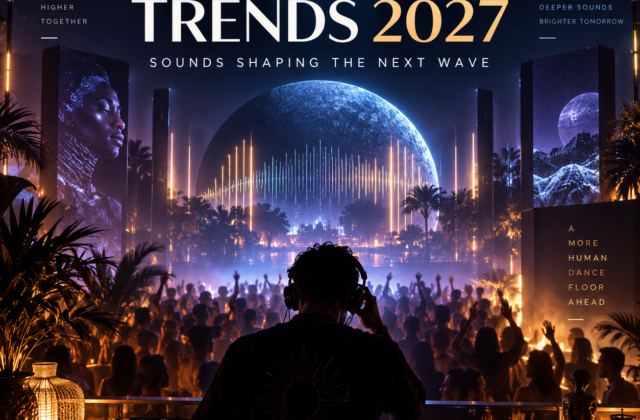
Where is house music heading in 2027? The answer is not one single sound. House music is moving in several directions at once: deeper grooves, stronger rhythmic identity, increasingly global influences, emotional melodies, renewed interest in vocals, smarter production technology and a growing desire for music that works beyond short-lived trends.
As 2026 moves toward its final months, the signs are already visible. Tech house remains powerful on club and festival lineups. Afro House continues to expand internationally. Melodic and progressive influences are becoming increasingly intertwined with traditional house structures. UK garage and groove-driven sounds are finding new audiences. At the same time, producers are experimenting with AI-assisted workflows without necessarily wanting the final music to sound artificial.
The result is a house scene that feels both familiar and increasingly difficult to divide into rigid categories.
Rather than predicting that one genre will suddenly replace another, the most interesting house music trends for 2027 point toward a more hybrid, emotional and rhythm-focused era.
House Music in 2027: The Short Answer
House music in 2027 is likely to become more groove-driven, global and stylistically fluid. Tech house will remain important, Afro House will continue influencing mainstream and underground production, melodic elements will spread across subgenres, and producers will increasingly combine organic percussion, recognizable vocals and modern sound design.
Technology will also play a larger role behind the scenes. AI tools, smarter stem separation, assisted mixing and faster creative workflows will help producers work differently, but artistic identity will become even more important precisely because the technical tools are becoming accessible to everyone.
If you are new to the genre itself, start with my guide to the history, sound and origins of house music. This article focuses instead on where that sound appears to be heading next.
Why 2026 Is Already Showing Us What Comes Next
House music enters 2027 from a position of strength.
A 2026 analysis of Miami Music Week published by Beatportal found that house-related music accounted for around 66% of the events analysed, with tech house alone representing roughly a third of the artists in its genre breakdown. Deep house, Afro House, melodic house and progressive styles were also represented across the programme.
You can explore the original Beatportal Miami Music Week 2026 analysis for the full breakdown.
Beatport’s wider 2026 mid-year observations point in a similar direction: tech house remains highly visible, while Afro House, melodic house & techno, UK garage and other hybrid club sounds continue to expand their influence.
None of this means 2027 will simply repeat 2026. Instead, these movements provide clues about which ideas are becoming part of the longer-term language of house music.
1. Groove Will Matter More Than Genre Labels
One of the strongest changes happening in electronic music is the gradual weakening of strict genre borders.
A modern house track may contain Afro-inspired percussion, a melodic techno-style breakdown, a deep house bassline, progressive pads and a vocal structure closer to pop — while still functioning perfectly inside a house DJ set.
In 2027, listeners are likely to care even less about whether a track fits perfectly inside one Beatport category.
What matters is whether the groove works.
This could be one of the most positive developments for house music because the genre has always been built on rhythm before classification. A strong four-on-the-floor foundation, a bassline with movement and a groove that develops naturally can support an enormous variety of sounds.
For producers, that creates more freedom. The question becomes less:
“Which subgenre am I supposed to make?”
and more:
“What kind of movement and emotion do I want this track to create?”
2. Tech House Will Evolve Rather Than Disappear
Tech house has been one of the dominant club sounds of recent years, and there is little evidence that it will suddenly disappear in 2027.
What may change is the formula.
The most repetitive versions of the genre risk becoming increasingly interchangeable as thousands of producers use similar drum libraries, bass presets, vocal samples and arrangement structures.
That pressure can actually push the genre forward.
Expect more tech house tracks to incorporate unusual percussion, deeper bass movement, old-school house references, garage swing, recognizable vocal hooks and influences from other electronic scenes.
The strongest tech house records may increasingly be the ones that still deliver the immediate physical energy DJs need while offering one element that listeners can actually remember after the set.
That could be a vocal phrase, an unconventional groove, a distinctive synth, a sample with personality or simply an arrangement that creates tension without relying on the same predictable drop.
3. Afro House Will Keep Influencing the Wider House Scene
Afro House has already become one of the most significant forces in modern electronic music, and its influence is unlikely to stop at one trend cycle.
Its importance goes beyond a particular percussion pattern.
The deeper shift is toward rhythm that feels alive: layered percussion, syncopation, warm bass movement, call-and-response elements, vocal textures and arrangements that build energy through repetition rather than constant impact.
Those ideas are now influencing melodic house, deep house, organic electronic music and increasingly mainstream productions.
I explored this shift in more detail in Why Afro House Is Becoming the Global Sound of 2026.
For 2027, the challenge will be authenticity.
As a style grows internationally, there is always a risk that its most obvious elements are copied while the cultural and musical depth behind them is ignored. Strong producers will go further than simply placing a few percussion loops over a house kick.
The most interesting Afro-influenced house music will come from artists who understand groove, space and musical dialogue — and who approach the roots of the sound with respect.
4. Melodic House Will Become More Rhythmic
Melodic house has often been associated with atmosphere, emotional chord progressions, cinematic pads and long evolving arrangements.
Those elements will remain important, but 2027 could bring more rhythmic energy back into the style.
Instead of treating melody and groove as separate worlds, producers are increasingly combining both.
Think warm chord progressions over stronger percussion. Emotional vocals over rolling basslines. Atmospheric synths supported by drums that still work on a serious club system.
This balance is especially interesting because it avoids two extremes.
A track does not need to become overly aggressive to work on a dancefloor, and it does not need to lose physical energy in order to become emotional.
This middle ground — where rhythm moves the body while melody carries the memory — could become one of the defining characteristics of house music in 2027.
5. UK Garage, Swing and Broken Rhythms Will Keep Crossing Into House
The renewed visibility of UK garage and related club sounds is also influencing house production.
Not every house track needs a perfectly straight rhythmic structure anymore.
Shuffled hi-hats, swung percussion, garage-inspired bass movement and broken rhythmic accents can create a sense of movement that feels immediately different from more rigid four-on-the-floor production.
This does not mean traditional house rhythm is disappearing. Quite the opposite.
The four-on-the-floor kick remains one of the strongest foundations in dance music. What changes is everything happening around it.
Small timing differences, percussion placement and swing can transform a simple pattern into something that feels much more human.
In a production landscape increasingly filled with technically perfect tools, imperfection and groove may actually become more valuable.
6. Recognizable Vocals and Nostalgia Will Stay Powerful
House music has always had a complicated but productive relationship with nostalgia.
Old vocal hooks return. Classic records are reworked. Piano house chords reappear. Disco references come back into fashion. Sounds associated with the 1990s or early 2000s suddenly feel fresh to a generation discovering them for the first time.
That cycle will continue in 2027.
But the strongest records will not simply copy the past.
They will reinterpret it.
A familiar vocal can be placed inside an entirely new rhythmic environment. Classic house chords can be combined with contemporary low-end production. A retro sample can become the emotional anchor inside an otherwise modern record.
There is a reason these elements survive: people remember them.
As streaming platforms and social networks expose listeners to enormous volumes of new music, memorability becomes valuable.
A production can be technically perfect and still disappear immediately. A simple vocal phrase or melodic motif can sometimes create a stronger identity than dozens of complex layers.
7. AI Will Become Part of the Workflow — Not the Identity
Artificial intelligence will almost certainly be more present in music production in 2027.
But that does not necessarily mean house music will suddenly sound AI-generated.
The more interesting development is happening behind the scenes.
Producers can already use AI-assisted tools for idea generation, stem separation, vocal experimentation, sound discovery, mixing suggestions, mastering assistance and creative problem solving.
These tools will become faster and more integrated into everyday production environments.
I explore many of these possibilities in my guide to the best AI tools for music producers.
But easier production creates a paradox.
If everyone has access to increasingly powerful tools, technical polish becomes less rare.
Taste becomes more important.
Knowing what not to add, when a groove is already strong enough, which idea deserves to become a full track and which generated element actually fits your identity will increasingly separate artists from content generators.
In that sense, AI may make human artistic direction more important, not less.
8. House Tracks Will Continue Living in Two Different Time Frames
Modern producers often face two competing realities.
Streaming and short-form platforms reward immediacy.
DJ culture rewards development.
A listener discovering a track on a phone may expect the main idea quickly. A DJ mixing two records in a club needs enough space to introduce, blend and develop them properly.
Instead of one format completely defeating the other, 2027 will probably continue the rise of multiple versions.
A track may exist as:
- a concise streaming or radio edit;
- a longer extended mix for DJs;
- a club-focused version with a different arrangement;
- or even short excerpts specifically designed for social discovery.
This is not necessarily a bad thing.
House music has always existed both as recorded music and functional DJ material. Digital distribution simply makes those different purposes easier to separate.
9. Emotional House Music Will Continue to Find an Audience
One of the directions that interests me most personally is the growing space between pure club functionality and emotional listening.
A house track can make people dance while still carrying nostalgia, warmth, melancholy, optimism or a sense of escape.
That emotional dimension can come from a vocal, a chord progression, a subtle guitar, an atmospheric pad, a particular sound texture or simply the way the arrangement creates and releases tension.
Not every record needs to be darker, harder or faster to feel powerful.
Some of the most memorable electronic tracks create intensity through emotion rather than aggression.
This also connects with the broader future of electronic music, where technology, genre fusion and global influences are increasingly balanced by a search for stronger artistic identity.
10. Independent Artists Will Need a World, Not Just a Track
The amount of music released every day continues to increase.
That makes good production necessary — but not sufficient.
Independent house producers entering 2027 increasingly need an ecosystem around their music.
A listener might discover one track through a DJ set, another through Spotify, a video through Instagram, an article through Google and the artist’s biography through an AI-generated search result.
All of those touchpoints contribute to the same identity.
That means releases, artwork, photography, stories, websites, playlists, live sets and social content should gradually feel like parts of the same universe.
The artists who stand out may not always be those releasing the greatest quantity of music. They may be the ones whose music is easiest to recognize and whose creative world feels coherent.
What House Producers Should Watch in 2027
If you produce house music, I would pay particular attention to these areas over the coming year:
- Groove before complexity: a simple rhythm with personality can outperform an overcrowded production.
- Percussion: more expressive rhythmic layers can make traditional four-on-the-floor structures feel fresh.
- Memorable vocals: one strong phrase can become the identity of an entire track.
- Melody with restraint: emotional does not have to mean overloaded.
- Genre crossover: Afro, garage, melodic, progressive and classic house ideas can coexist naturally.
- Extended mixes: DJ-friendly arrangements still matter even when streaming edits become shorter.
- AI-assisted workflow: use technology to accelerate experimentation, not to replace your musical decisions.
- Artist identity: sound, imagery and storytelling are becoming increasingly connected.
My Perspective as a House Music Producer
What excites me about house music going into 2027 is that there does not seem to be one compulsory direction.
I have always been more attracted to electronic music when groove and emotion can exist together. A track can be warm, melodic and atmospheric while still needing enough rhythm and energy to work on a dancefloor.
For me, that balance is more interesting than simply following whichever subgenre is currently receiving the most attention.
Technology can help us experiment faster than ever before. We can test arrangements, manipulate vocals, explore sounds and generate ideas in ways that would have taken much longer only a few years ago.
But faster tools do not automatically create better music.
The part I still find most important is choosing what feels right: the moment when a chord creates an emotion, when a groove finally starts breathing, when a vocal suddenly gives a track meaning, or when removing one element makes everything else stronger.
That is where I believe house music will remain human.
House Music Trends 2027 at a Glance
- Tech house remains influential but becomes more hybrid.
- Afro House continues influencing the wider house ecosystem.
- Melodic house becomes more rhythm-focused.
- Garage swing and broken rhythmic influences become more common.
- Vocals and reinterpretations of classic sounds remain powerful.
- AI becomes increasingly invisible inside production workflows.
- Streaming edits and extended DJ mixes continue to coexist.
- Emotional electronic music gains space alongside harder club styles.
- Genre boundaries continue becoming less important.
- Independent artists increasingly build complete creative ecosystems around their releases.
The Future of House Music Is Still About Connection
House music has survived more than four decades of technological change because its fundamental purpose has never depended on one machine, one subgenre or one trend.
It is built around connection.
A kick drum establishes the pulse. A bassline creates movement. Repetition creates anticipation. Melody creates memory. A room full of people turns those elements into something larger than the recording itself.
The production tools will continue changing in 2027. Genre names will shift. New scenes will emerge. Algorithms will influence discovery. AI will become more capable. Some sounds will explode in popularity and others will disappear just as quickly.
But the strongest house music will probably continue doing what it has always done best:
making people feel something while making them move.
FAQ: House Music Trends in 2027
What are the biggest house music trends in 2027?
The biggest house music trends heading into 2027 include stronger rhythmic grooves, continued Afro House influence, evolving tech house, more melodic production, garage-inspired swing, memorable vocals, AI-assisted workflows and increasingly fluid genre boundaries.
Is tech house still popular in 2027?
Tech house is likely to remain one of the most important club-oriented house styles in 2027. However, the sound is evolving as producers introduce more melodic elements, garage swing, unusual percussion, classic house influences and more recognizable vocal ideas.
Will Afro House continue growing in 2027?
Afro House is likely to remain an important influence because its rhythmic, organic and emotional qualities are already spreading into melodic house, deep house and mainstream electronic music. The strongest future productions will focus on musical depth and respect for the cultural roots behind the sound rather than simply copying surface-level trends.
How will AI affect house music production in 2027?
AI will increasingly assist producers with idea generation, stem separation, vocal experimentation, sound discovery, mixing and mastering workflows. However, artistic taste, groove, arrangement, emotional direction and identity will remain human decisions.
What BPM will house music use in 2027?
There is unlikely to be one dominant BPM. Traditional house will continue to exist around familiar club tempos, while tech house, Afro House, melodic house, progressive styles and garage-influenced tracks will use different tempo ranges according to their energy and purpose.
Is house music becoming more melodic?
Melody is becoming increasingly important across several house subgenres, but often without replacing groove. Many modern productions combine emotional chords, vocals and atmospheric textures with strong percussion and bass movement, allowing the music to work both emotionally and physically.
What should house music producers focus on in 2027?
Producers should focus on groove, artistic identity, memorable musical ideas and strong arrangements rather than simply copying current trends. Technology can speed up production, but recognizable taste and emotional direction are likely to become even more valuable as production tools become easier to access.
Discover more from Silvano Dio
Subscribe to get the latest posts sent to your email.